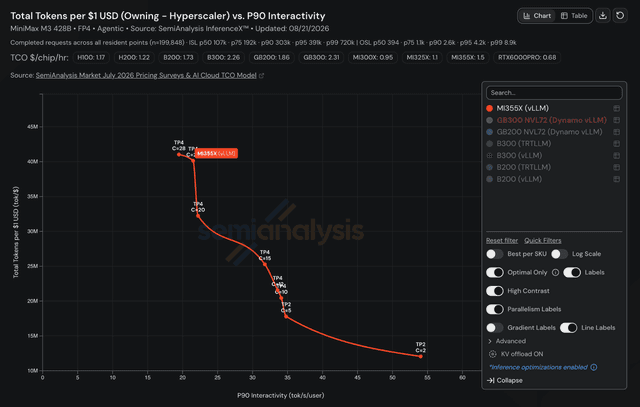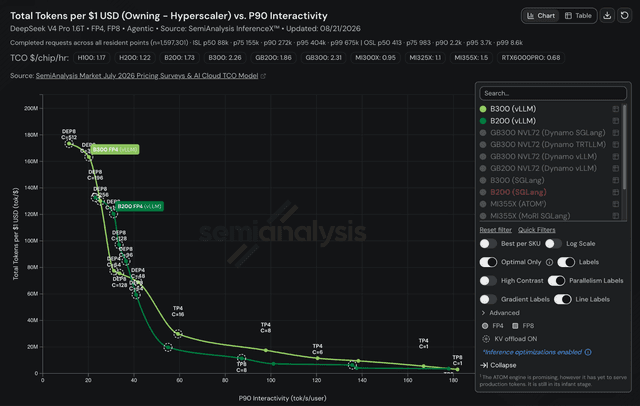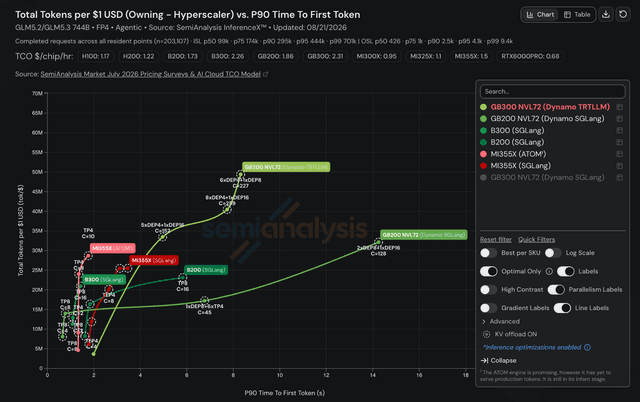
NVIDIA absolutely destroys all competitors on MiniMax M3 432B. AMD software performance is horrible on MiniMax, especially at high context length, which we attribute to AMD engineering leadership incentivizing tuning only for short context single turn workloads and ignoring long context multi turn workloads.
Within the NVIDIA field, B300 TRT-LLM at TP2 owns the M3 crown.
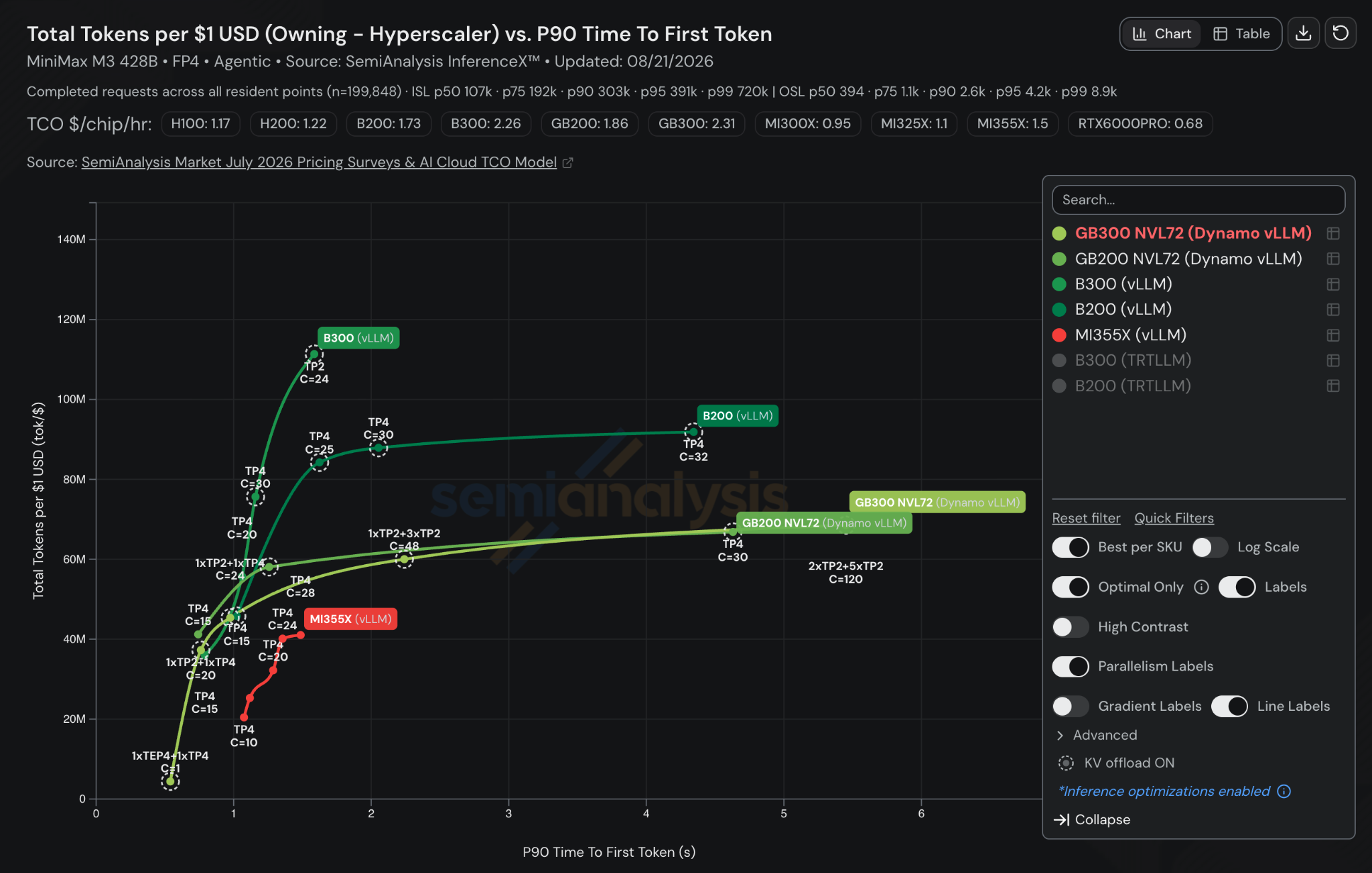
The missing DP-attention points
There is a lack of DP-attention points on the M3 frontier, and the absence is informative. Data-parallel attention is non-optimal on M3 because KV cache locality becomes a routing constraint.
The numbers make the mechanism concrete. For GB200 at concurrency 40, TP4/EP4/DPA gets 0.60x the throughput of plain TP4 at more than 3x the p90 TTFT. At concurrency 32 it hits 28.8% of cache against 96.0% theoretical. Each DP rank owns a private quarter of the pool, so a 300k-token session re-landing on the wrong rank recomputes everything.
That gap between 28.8% measured and 96.0% theoretical is the whole story of prefix reuse under data parallelism: the cache was large enough, and the session simply was not sent to the rank that held it.
No decode config with expert parallelism appears on the M3 frontier either, likely because the concurrency is not high enough to balance the loads across all experts.
vLLM against TRT-LLM
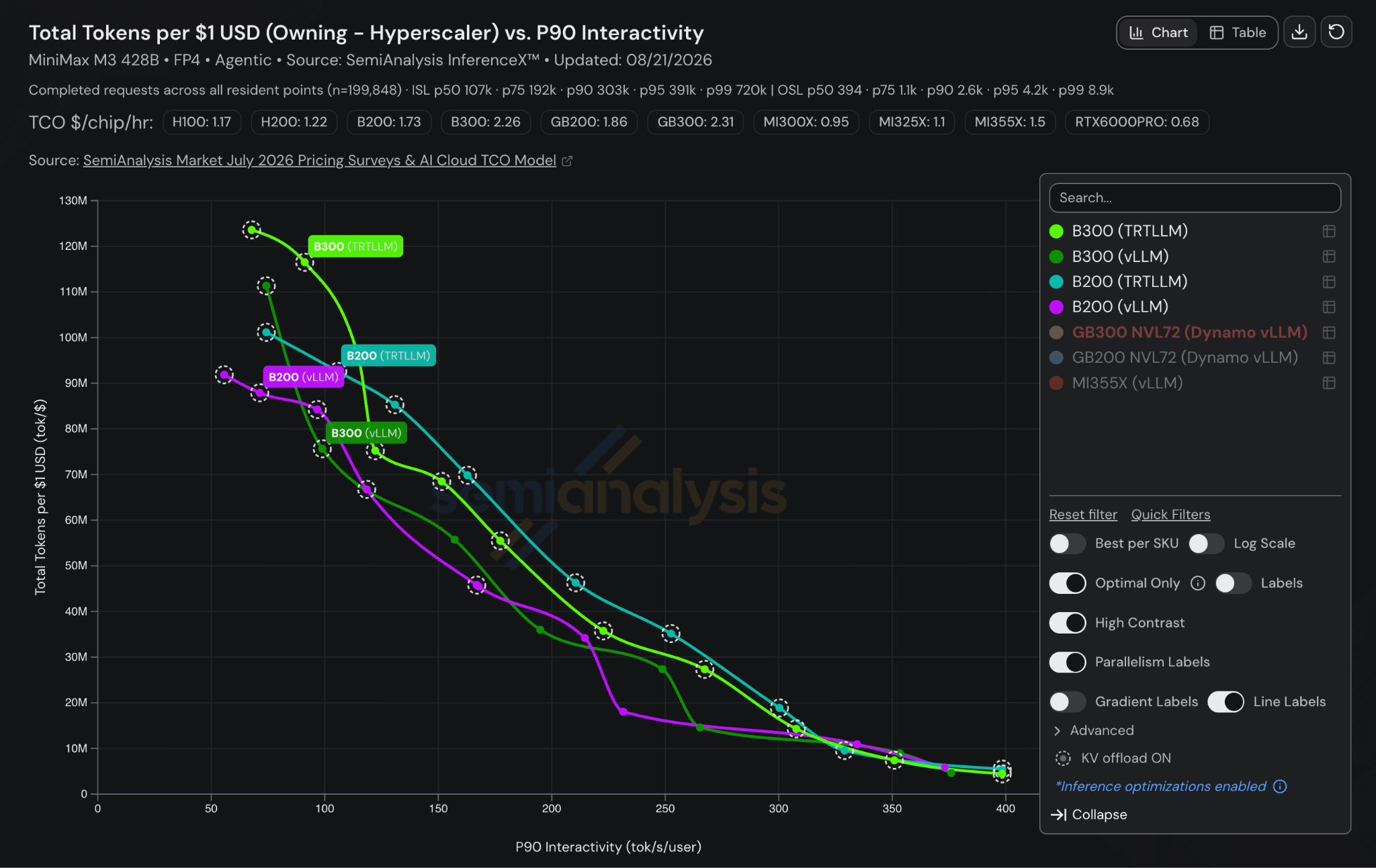
It is worth mentioning that vLLM performance is very comparable to TRT-LLM in terms of throughput versus p90 interactivity. On throughput versus p90 TTFT, vLLM performs better.
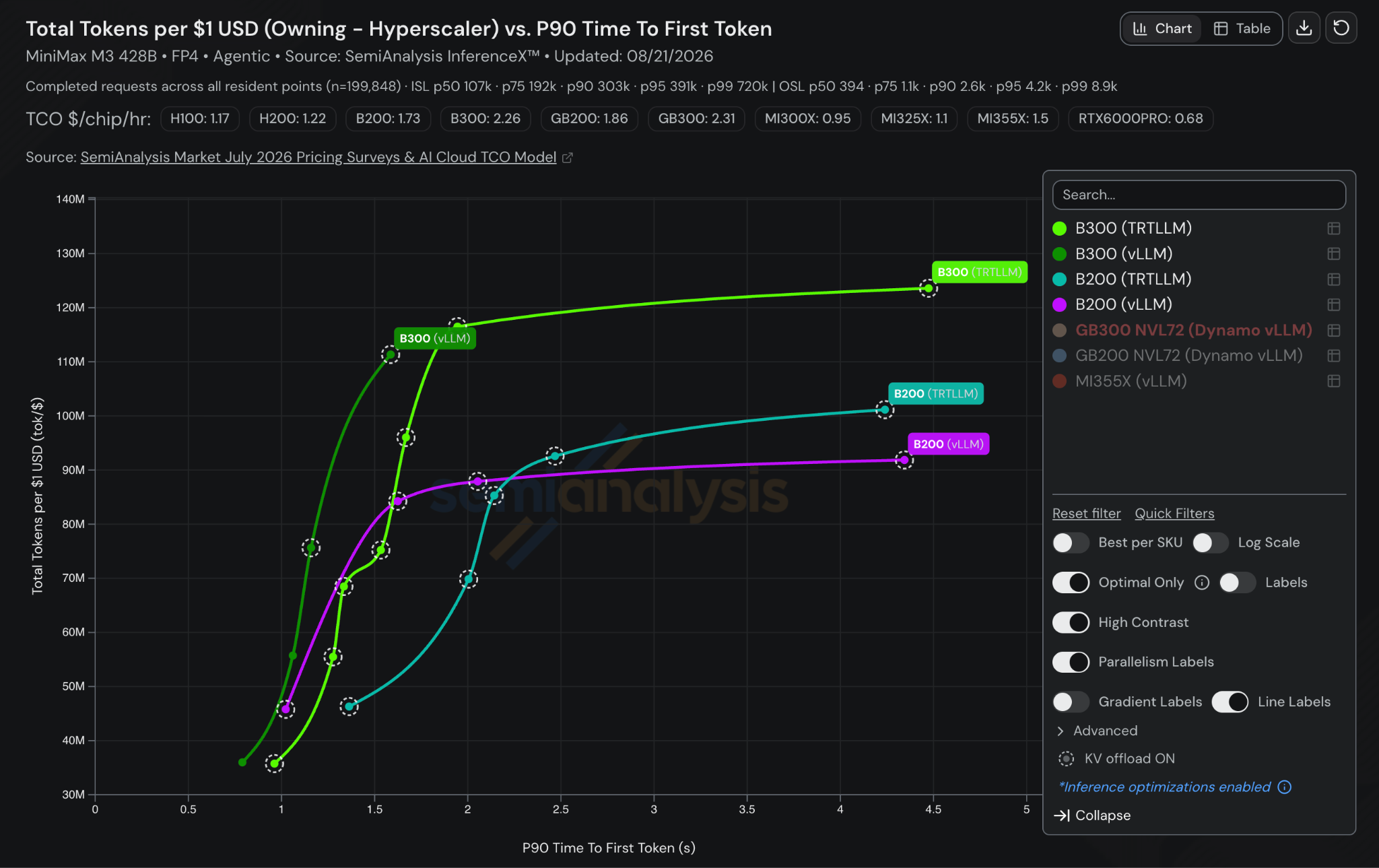
Which of the two you prefer therefore depends on which axis your product is written against, which is the recurring argument for reading interactivity and first-token latency together rather than picking whichever chart flatters a conclusion.
These results are one slice of AgentX 1.0. The full analysis, the replay methodology, and the 70+ upstream PRs the benchmark drove are in AgentX - InferenceXv3: Does the CUDA Moat Hold Up in Agentic Inferencing?. Every point is explorable on the free dashboard.
All articles and posts are © SemiAnalysis. All rights reserved. The AGPL-3.0 license covering the application source code does not apply to article content.