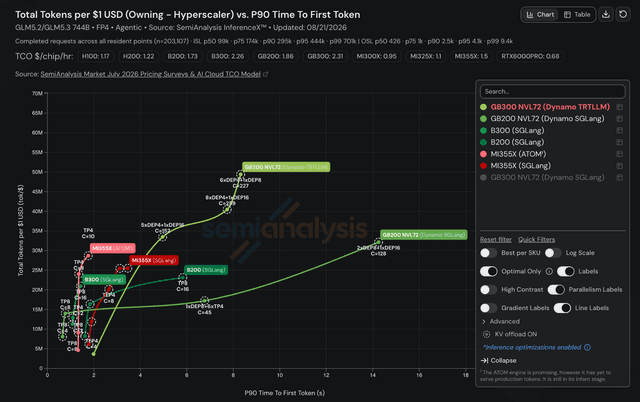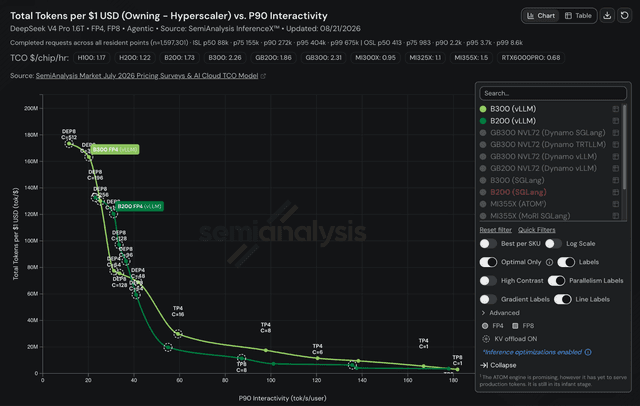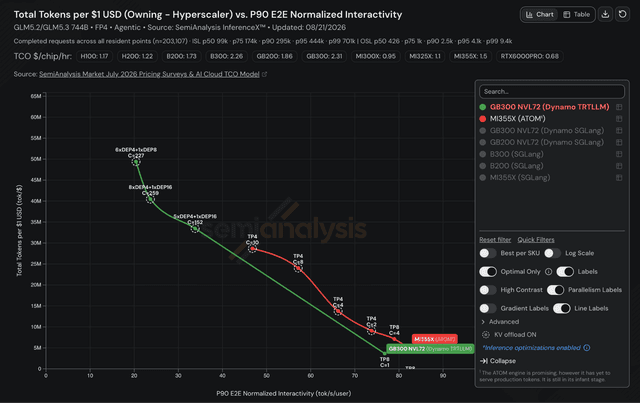
DeepSeek V4 Pro 0813 is an ultra popular frontier open weight model from China, with roughly 1.6 trillion parameters and 49 billion active. It is also the model where the AMD and NVIDIA race on AgentX was closest, and where the ranking changed inside a single week.
The workload matters here. AgentX replays real agentic coding sessions rather than a fixed prompt, and across all DeepSeek V4 runs the input length distribution came out at p50 88k, p90 272k, p95 404k, and p99 675k tokens, against an output distribution of p50 413, p90 2.2k, p95 3.7k, and p99 8.6k. That is a different machine problem from 8k1k.
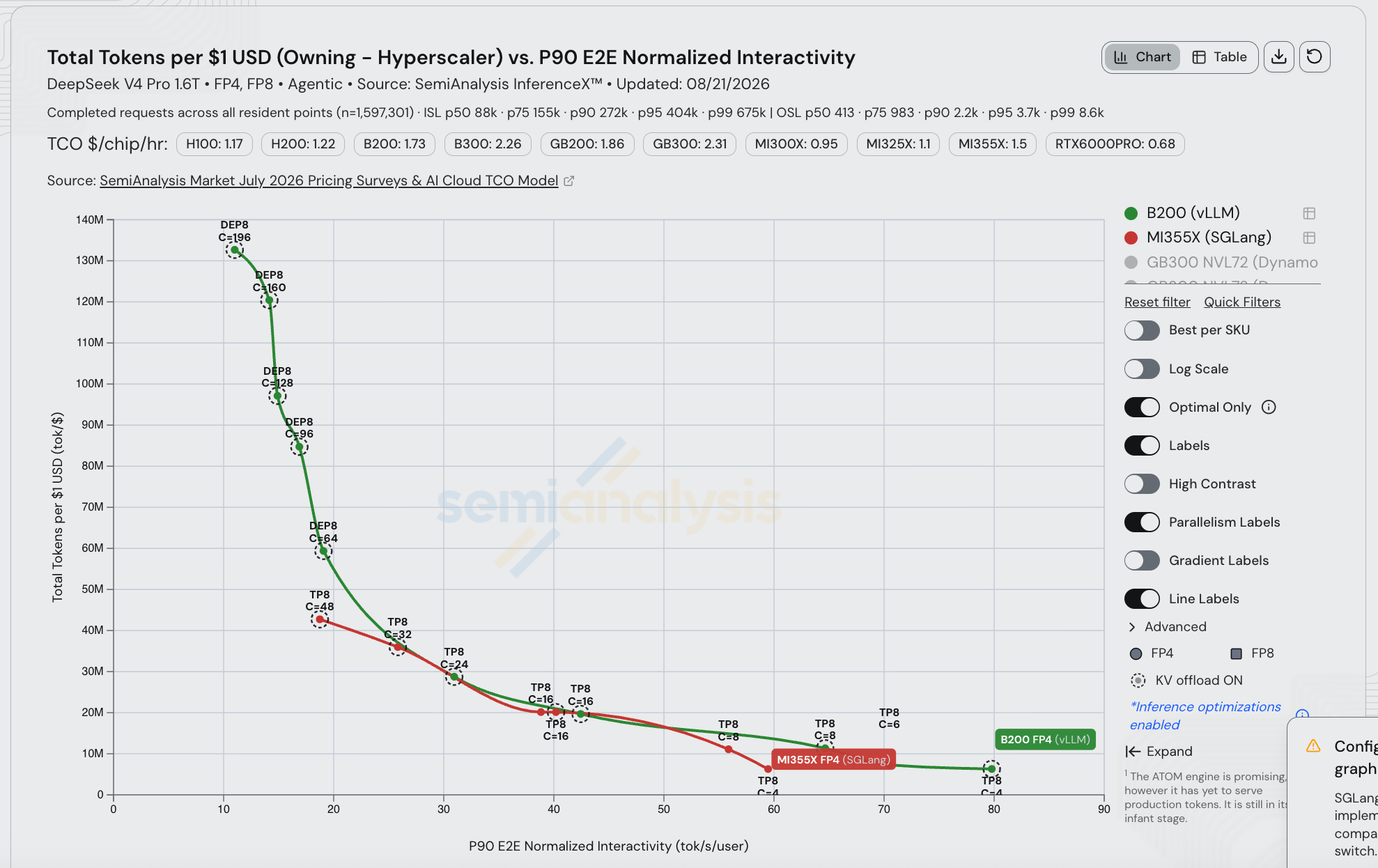
Before August 21, 2026, AMD's strong MI355X SGLang development team was matching B200 vLLM on performance per dollar for end to end performance. That is a real result and worth stating plainly.
It was also not the whole board. B300 vLLM and B200 SGLang were already beating MI355X at the same time.
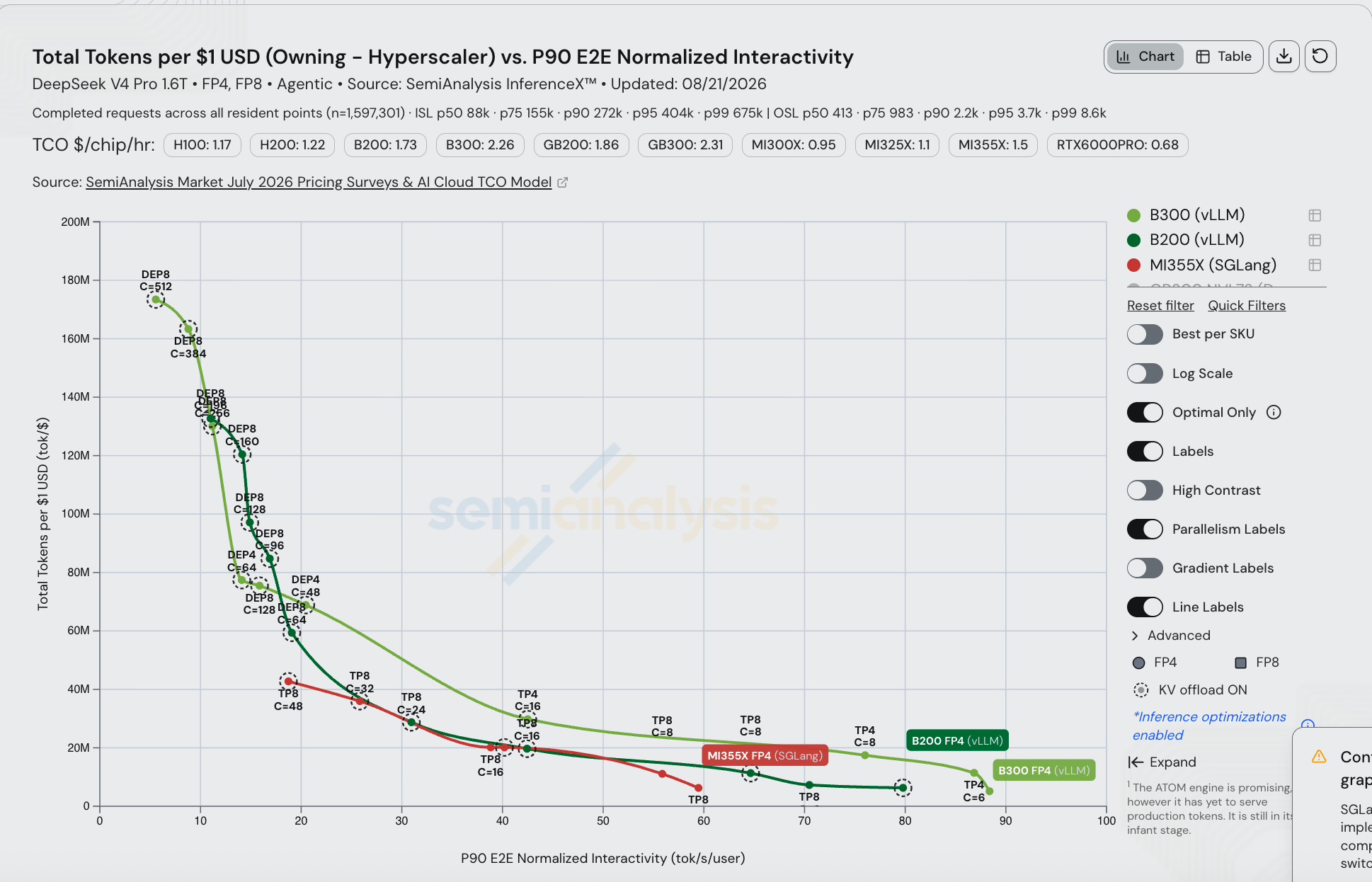
After August 21, optimizations in vLLM from Inferact and NVIDIA pushed B200 performance per dollar past MI355X. This is a close race rather than a settled one, and AMD has published its own list of DeepSeek V4 vLLM optimizations with plenty left on it.
The ATOM asterisk
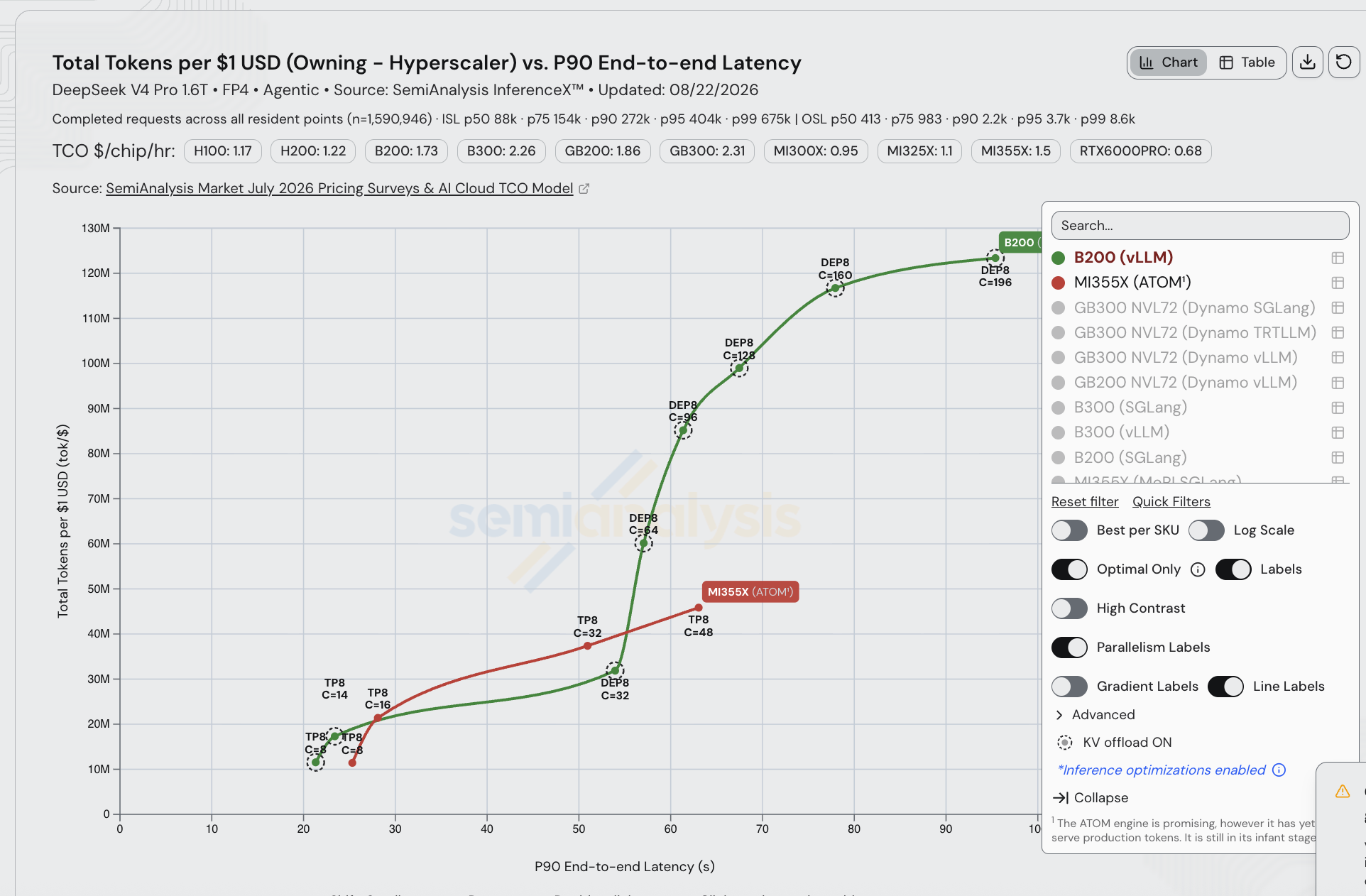
On end to end latency, ATOM on MI355X beats B200 vLLM. It does not beat B300 or B200 SGLang, and the more important caveat is deployment: most AI labs in China or the west do not want to run ATOM in production, so a win that exists only under the vendor engine does not describe what a customer on an upstream stack receives. Single node open-source performance on MI355X, meaning vLLM, still trails ATOM.
Where MI355X is actually competitive
Overall MI355X performs decently against B200 and B300. Performance is most comparable at the lower throughput and lower latency part of the curve, where only tensor parallelism and more rudimentary kernels are deployed. The gap opens at high throughput, where AMD needs to optimize its DEP kernels, and it opens despite MI355X carrying 1.5x the HBM of B200.
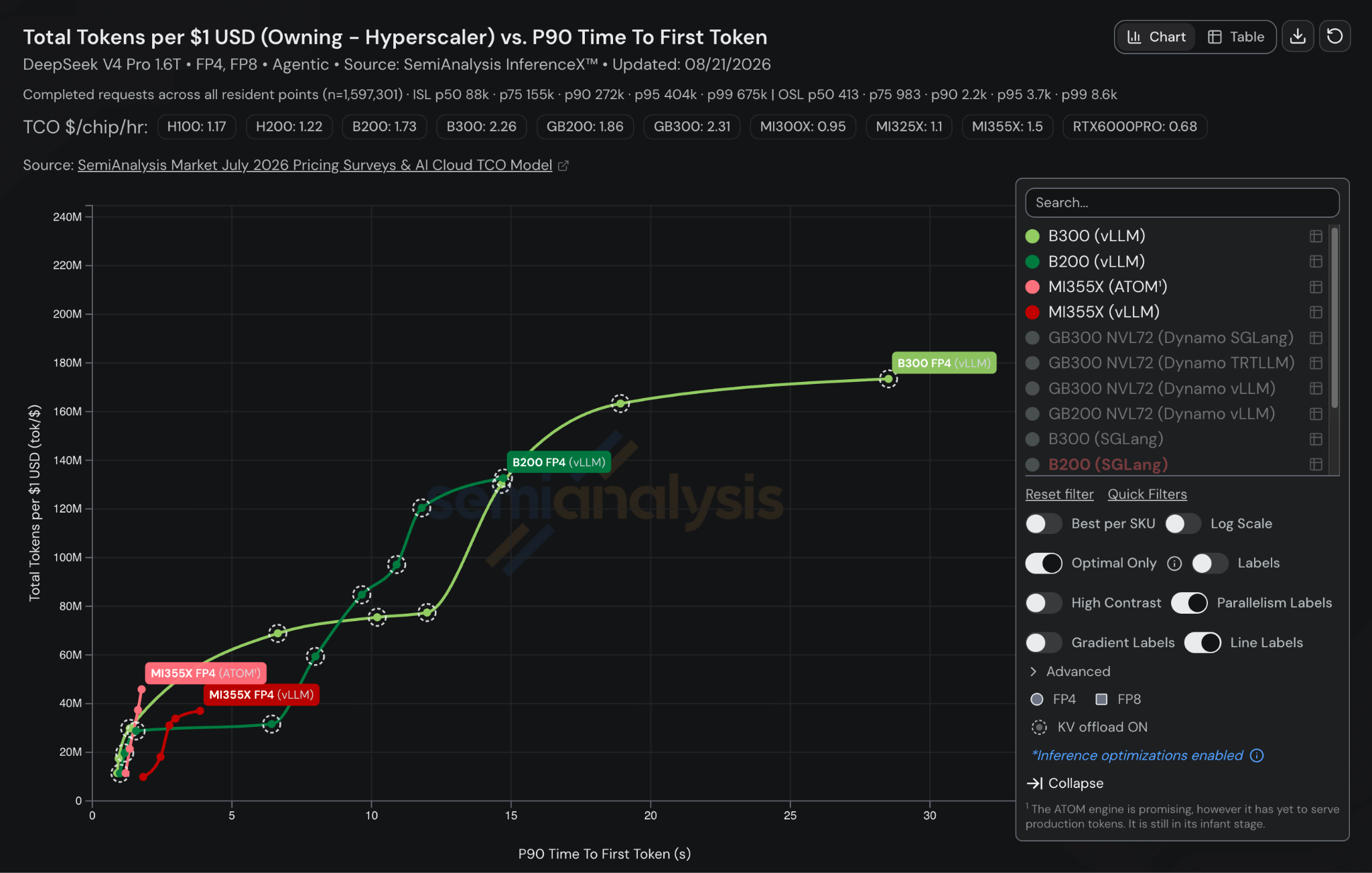
Read both axes together. A configuration can look strong on throughput against interactivity and give that back on p90 time to first token, which is why the comparison above is plotted against TTFT rather than interactivity alone.
These results are one slice of AgentX 1.0. The full analysis, the replay methodology, and the 70+ upstream PRs the benchmark drove are in AgentX - InferenceXv3: Does the CUDA Moat Hold Up in Agentic Inferencing?. Every point is explorable on the free dashboard.
All articles and posts are © SemiAnalysis. All rights reserved. The AGPL-3.0 license covering the application source code does not apply to article content.