
AgentX industry impact · Kernels
ROCm AITER
Long-context execution in ATOM, AMD vLLM, and AMD SGLang depends on matching lower-level AITER kernels, because a parallelism strategy at the engine layer is only real if the kernels can express it.
- tokens covered by widened row indexing
- >131k
- addressing for pools above 4 GB
- 64-bit
- rows protected from silent wrong-row access
- ~150M
Context-parallel process groups
Prefill context-parallel process groups provide the extra query-sharding dimension that prefill context parallelism needs, and also widen fused-kernel row indexing for prompts above 131,000 tokens. Decode context parallelism (DCP) shards KV across the tensor-parallel GPUs already present, so a longer sequence or a larger batch fits without replicating the whole cache on every rank.
Upstream pull requests
Address width: a failure short requests never reach
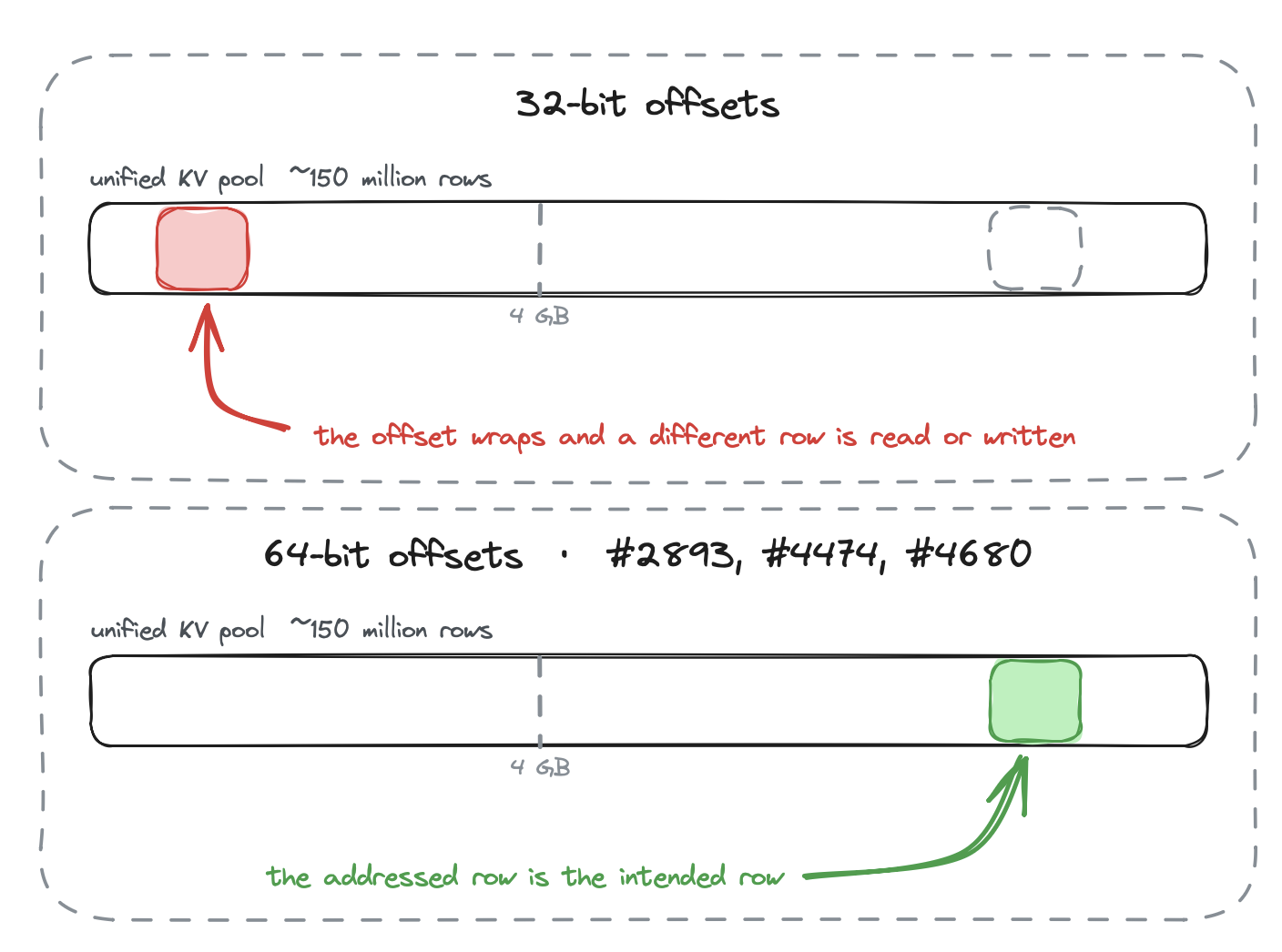
Large caches exposed a class of failure that short fixed requests essentially never reach: address width. A 32-bit offset is entirely adequate until a single cache pool crosses the boundary, at which point the arithmetic wraps and the kernel addresses the wrong row without any error being raised.
AITER added runtime 64-bit dispatch for batch prefill above 4 GB, 64-bit MLA offsets above 2 GB, and 64-bit addressing throughout DeepSeek-V4’s unified cache paths — the last preventing silent reads and writes to the wrong row in pools of roughly 150 million rows.
Upstream pull requests
Persistent MLA decode for common head packings
DeepSeek-V4 decode also gained a persistent MLA kernel for 64-head and 128-head MTP packings. Those two head counts are what ordinary decoding and speculative verification actually produce, so this gives the engine a dedicated long-context path for its common shapes instead of treating them as incidental variants of a kernel written for short contexts. It is the same argument as the vLLM AITER sparse-MLA selection: at long context the generic path is not a modest compromise, it is the wrong kernel.
Upstream pull requests
Other projects
Inference engine
vLLM
Hybrid-attention prefix retention, CPU KV offload for hybrid models, and a narrowed store and load path.
Read the optimizations →Inference engine
SGLang
Sliding-window allocation, HiCache hybrid offload, runtime-scalar context length, and cache-aware DP routing.
Read the optimizations →Inference engine
TensorRT-LLM
Boundary-aware incremental tokenization, disaggregated KV descriptor coalescing, and scheduler-lifetime fixes.
Read the optimizations →Inference engine
AMD ATOM
Sparse checkpoint retention, recurrent-state checkpoints, CPU offload ownership, and long-prefill parallelism.
Read the optimizations →Router and orchestration
NVIDIA Dynamo
Batched KV matching, request-lease ownership, cheaper router state, and a leaner request plane.
Read the optimizations →KV-cache layer
LMCache
Chunked external-cache loading, hybrid-group storage, AMD Instinct enablement, and DCP-aware offload.
Read the optimizations →Transfer engine
Mooncake
GPU-direct RDMA on ROCm through HIP dmabuf, plus a published ROCm wheel and release path.
Read the optimizations →