
AgentX industry impact · Inference engine
vLLM
Working alongside vLLM maintainers from Inferact, Red Hat, NVIDIA, and AMD, we used AgentX’s realistic replayer as a north star. The resulting fixes landed upstream, and most of them transfer directly to production.
- prefix-cache hit rate at 1M context
- >95%
- output throughput with hybrid CPU offload
- +81.7%
- mean end-to-end latency
- −46.6%
Hybrid-attention prefix caching
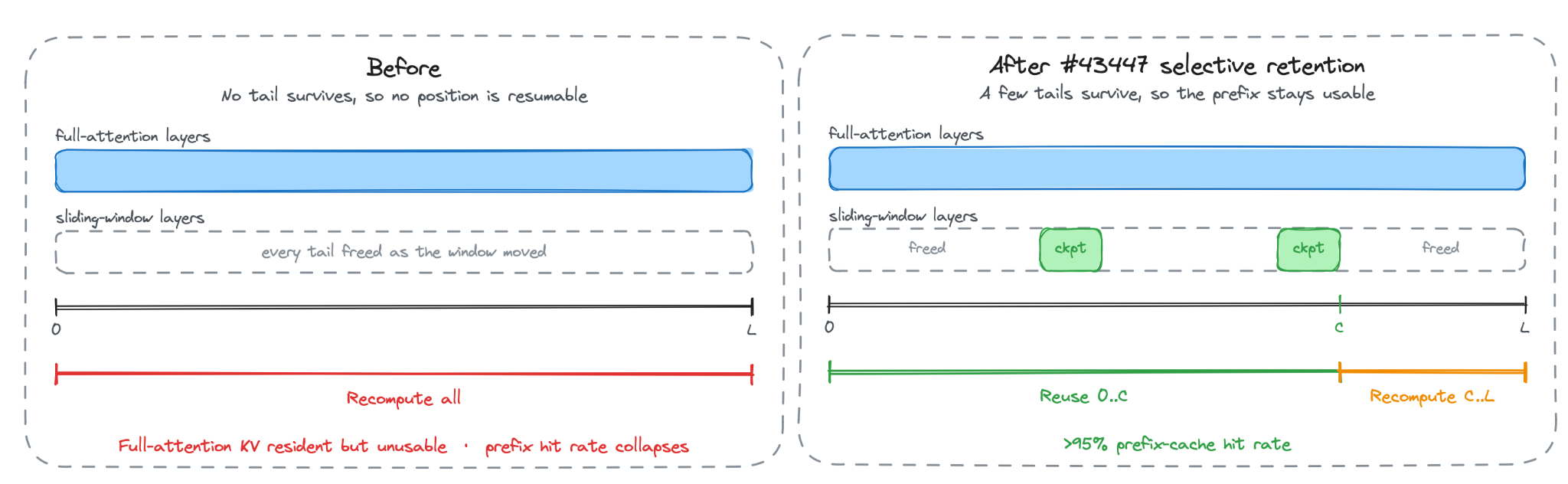
vLLM improved hybrid-attention prefix caching so short-lived sliding-window allocations do not evict useful long-context checkpoints. Selective retention preserves sparse replay boundaries and reported a prefix-cache hit rate above 95% with fourteen concurrent requests and contexts up to one million tokens.
The same reachability policy was applied to Mooncake, and unreachable sliding-window lookups were removed. Earlier follow-up work also stopped offloading sliding-window blocks that could never be reused, and kept the speculative lookahead block inside the retained prefix.
Upstream pull requests
CPU KV offload for hybrid models
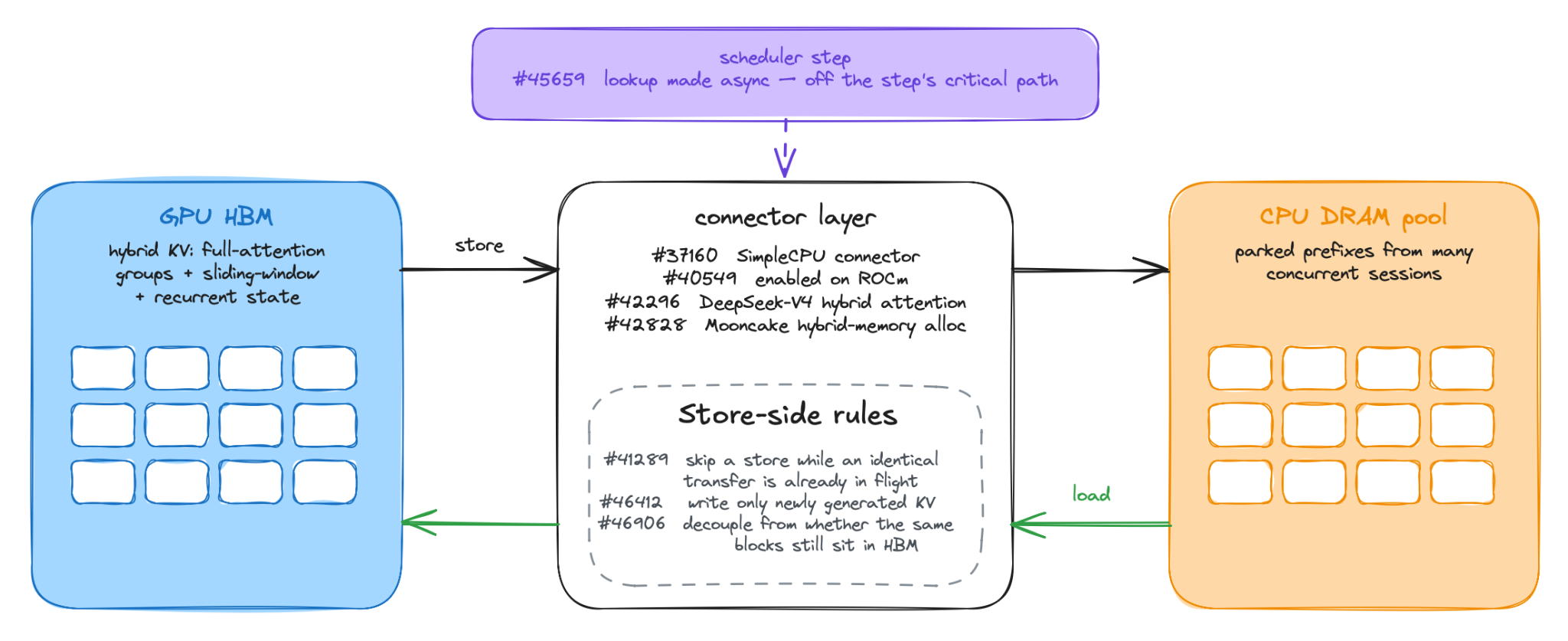
Highly concurrent agentic workloads require offload, and AgentX drove the work that made CPU KV offload usable for hybrid models rather than only for uniform full-attention models. The distinction matters: a uniform model has one KV layout per token, so a connector can describe what to save with a single block geometry. A hybrid model carries several cache groups at once, each with a different shape and a different lifetime, and a connector that assumes one uniform layout cannot express which group a given block belongs to. Offload was therefore unavailable for exactly the models whose long sessions needed it most.
The general SimpleCPU connector came first, was enabled on ROCm, and was then extended to DeepSeek-V4 hybrid attention, which reported 81.7% higher output throughput and 46.6% lower mean end-to-end latency against recomputing the prefix once it no longer fits in HBM. Mooncake gained the equivalent hybrid-memory allocation support.
Upstream pull requests
Narrowing the store path
Profiling realistic workloads showed that once offload worked at all, the cost moved to the store path, which was writing too much and too often. Three rules narrowed it.
A store is now skipped while an identical transfer is already in flight, so concurrent sessions sharing a prefix pay for it once rather than once each. A store covers only newly generated KV ranges, so a session that extends its history writes the delta instead of rewriting the whole prefix every turn. And a store no longer depends on whether the same blocks still sit in HBM, so work already scheduled is not discarded when an eviction lands underneath it.
Upstream pull requests
Keeping lookups off the critical path
The load path was tuned separately, because lookups happen on every scheduling decision rather than only when data actually moves. Making lookups asynchronous in the scheduler path keeps the connector off the step’s critical path, so a step no longer waits on CPU-side cache queries before it can admit work.
Compact zero-copy lookup keys, parallel receive-side loading, and prebuilt Mooncake key strings then removed the CPU and transport overhead that remained.
Upstream pull requests
Correctness and accounting under long-lived hybrid state
Long-lived hybrid state forced correctness and accounting fixes that fixed-shape requests rarely reach. vLLM now emits cache events per hybrid cache group, strides distributed-context stores correctly, and computes lookup prefixes correctly under distributed context and prefill. A related context-parallel accounting change aligns cache ownership with sharded token ranges.
Speculative state is now propagated across merged Mooncake groups and through the SimpleCPU coordinator, which prevents the repeated-turn cache from silently losing EAGLE state.
Upstream pull requests
ROCm: below the cache layer
On the ROCm side the recent work continues below the cache layer, where the remaining cost is per-layer rather than per-request. Once the prefix survives and arrives on time, what is left is the decode step itself, and a decode step that runs thousands of times per session pays for every avoidable copy and every mismatched kernel. Three open changes attack that layer.
A Kimi-K3 change writes KDA decode results directly into the layer output buffer, removing one device copy per KDA layer; the saving is small in isolation and repeated for every layer of every decoded token. A second change selects an AITER sparse-MLA decode kernel in place of the generic path, and reported 5.22% higher AgentX output throughput with substantially lower inter-token latency.
The third is a useful illustration of how much the measurement shape matters. A companion change routes full-graph attention projections through tuned AITER GEMMs and reached a 2.3% gain on fixed sequences at low concurrency. A kernel-level change can show a clean gain on uniform shapes and then be swamped, on an agentic trace, by the cache and scheduling variance the trace introduces.
Upstream pull requests
Other projects
Inference engine
SGLang
Sliding-window allocation, HiCache hybrid offload, runtime-scalar context length, and cache-aware DP routing.
Read the optimizations →Inference engine
TensorRT-LLM
Boundary-aware incremental tokenization, disaggregated KV descriptor coalescing, and scheduler-lifetime fixes.
Read the optimizations →Inference engine
AMD ATOM
Sparse checkpoint retention, recurrent-state checkpoints, CPU offload ownership, and long-prefill parallelism.
Read the optimizations →Kernels
ROCm AITER
Context-parallel process groups, 64-bit addressing for large cache pools, and persistent MLA decode kernels.
Read the optimizations →Router and orchestration
NVIDIA Dynamo
Batched KV matching, request-lease ownership, cheaper router state, and a leaner request plane.
Read the optimizations →KV-cache layer
LMCache
Chunked external-cache loading, hybrid-group storage, AMD Instinct enablement, and DCP-aware offload.
Read the optimizations →Transfer engine
Mooncake
GPU-direct RDMA on ROCm through HIP dmabuf, plus a published ROCm wheel and release path.
Read the optimizations →