
AgentX industry impact · Inference engine
TensorRT-LLM
TensorRT-LLM’s AgentX work starts at the frontend, with a cost that exists only because the workload is multi-turn, and then follows the request down into transfer granularity, kernel selection, and scheduler lifetime.
- mean tokenization time per turn
- 185.1 ms → 11.3 ms
- request-critical KV p99 at concurrency 5
- 26.74 s → 125 ms
- per-user output throughput from context graphs
- +12.58%
Boundary-aware incremental tokenization
Every turn of a conversation re-sends the entire history plus a little more, and the naive implementation re-tokenizes all of it. Tokenization is cheap per kilobyte and ruinous when the same 100,000 tokens are tokenized again on every turn.
The obvious fix — tokenize only the new suffix — is wrong in a way that is easy to miss, because byte-pair encoding is not position-independent. Tokens can merge across the join, so splitting the text at the boundary and concatenating the two token sequences can produce a different sequence than tokenizing the whole string, which quietly diverges from the sequence the prefix cache was built against.
TensorRT-LLM implements boundary-aware incremental tokenization, which finds the rendered-text common prefix, rolls back one complete token so any merge that spans the join is recomputed, and tokenizes only the changed suffix from there. On the Qwen3.5 AgentX trace it matched full tokenization on all 1,087 transitions — the correctness claim tested rather than assumed — and reduced mean processing time from 185.1 ms to 11.3 ms. A fixed 8k/1k request has no prior rendered turn to reuse, so none of this appears there.
Relatedly, chat-template rendering moved into the input-processing pool, so a long template no longer serializes the main request loop behind it.
Upstream pull requests
Disaggregated KV movement and descriptor granularity
The MiniMax-M3 work focuses on disaggregated KV movement, where the failure is one of granularity. When prefill and decode do not agree on head layout, the KV for one logical request stops being a few large contiguous regions and becomes thousands of small strided pieces, each of which turns into its own transfer descriptor. The bytes moved are unchanged; the per-descriptor overhead is what explodes, and it explodes worst on exactly the long prompts that matter.
Corrected multi-pool mapping and a chunked NIXL bounce path coalesce those pieces through a bounded reusable arena, trading an extra staging copy for orders of magnitude fewer descriptors. The AgentX diagnostic reduced request-critical KV p99 from 26.74 seconds to 125 ms at concurrency five, and from 10.15 seconds to 288 ms at concurrency forty.
Nonblocking context-transfer polling protects the same path by reaping completed transfers even when scheduling stalls, breaking a feedback loop in which finished KV blocks stay pinned and prevent new admissions. A separate draft-cache transfer proposal was closed without merge and should not be counted as shipped TensorRT-LLM behavior.
Upstream pull requests
Execution paths for irregular long context
TensorRT-LLM also moved irregular long-context work onto more efficient execution paths. Context graph producers for MiniMax-M3 capture stable sparse producers while leaving request-dependent attention eager, and per-user output throughput improved by 12.58% in its AgentX test. An open native KV-event production change reduces allocation and conversion work on the KV-aware routing path.
Upstream pull requests
Kernel selection and scheduler lifetime
AgentX also exposed kernel-selection and scheduler-lifetime failures that only appear at scale and duration. Two are about which kernel gets picked. MiniMax-M3 added CuTeDSL choices to MXFP8 autotuning, widening the candidate set and improving output throughput per GPU by roughly 7 to 10% at low-concurrency aggregated points. In the opposite direction, TensorRT-LLM disabled corrupt split-K MoE tactics after they crashed five of seven AgentX runs, with no crashes in seven matched runs afterwards. A tactic that is fast and wrong is worse than one that is merely slow, and an autotuner will select it enthusiastically unless it is removed from the pool.
The other two are lifetime bugs, which are the characteristic failure of long runs rather than large ones. Sequence-slot headroom and consistent slot-indexed buffer sizing handle the transient overlap where a completing request and a newly admitted one both need a slot — a window that a steady stream of arrivals and departures hits constantly and a fixed batch never hits at all. A later attention-data-parallel dummy-request fix kept nine Qwen3.5 disaggregated cells alive where most earlier cells had failed within minutes: the difference between a configuration that benchmarks and one that survives a session.
Upstream pull requests
Pipelined KV transfer for very long prompts
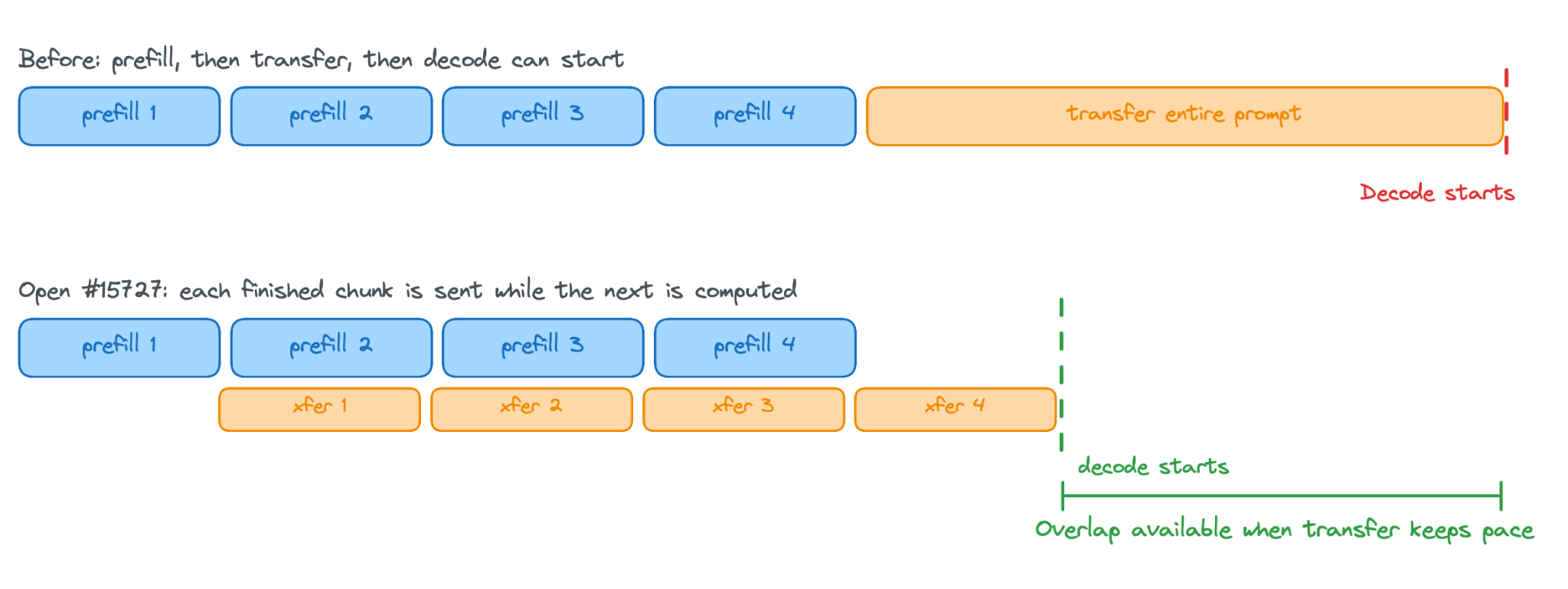
Two open transfer changes target very long disaggregated prompts, and together they show how a fix can create the next bottleneck. In the default arrangement a decode worker cannot start until the entire prompt has been prefilled and then transferred, so two expensive phases run back to back even though the first produces its output incrementally. Pipelined KV transfer begins sending each completed prefill chunk as it lands, so transfer overlaps prefill compute and only the final chunk is on the critical path.
That change makes chunk handling frequent, which exposes work that used to happen once. Its follow-up retrieves only the block IDs belonging to the current chunk rather than the whole prompt’s block list each time. For a 128,000-token prompt split into 1,024-token chunks, that is the difference between building a 4,096-entry list once and rebuilding it 128 times for every layer group — a per-chunk cost that scales with total prompt length, which is exactly the shape that eats the gain the pipelining just bought.
Upstream pull requests
Other projects
Inference engine
vLLM
Hybrid-attention prefix retention, CPU KV offload for hybrid models, and a narrowed store and load path.
Read the optimizations →Inference engine
SGLang
Sliding-window allocation, HiCache hybrid offload, runtime-scalar context length, and cache-aware DP routing.
Read the optimizations →Inference engine
AMD ATOM
Sparse checkpoint retention, recurrent-state checkpoints, CPU offload ownership, and long-prefill parallelism.
Read the optimizations →Kernels
ROCm AITER
Context-parallel process groups, 64-bit addressing for large cache pools, and persistent MLA decode kernels.
Read the optimizations →Router and orchestration
NVIDIA Dynamo
Batched KV matching, request-lease ownership, cheaper router state, and a leaner request plane.
Read the optimizations →KV-cache layer
LMCache
Chunked external-cache loading, hybrid-group storage, AMD Instinct enablement, and DCP-aware offload.
Read the optimizations →Transfer engine
Mooncake
GPU-direct RDMA on ROCm through HIP dmabuf, plus a published ROCm wheel and release path.
Read the optimizations →