
AgentX industry impact
Optimizations for Agentic Workloads
The most useful thing AgentX produced in its first months was not the open-source datasets. It was 50+ upstream pull requests from AgentX partners, optimizing real-world agentic workloads with AgentX as the north star.
- upstream PRs
- 50+
- upstream projects
- 8
- layers of the stack
- 5
- the north star trace
- AgentX
AgentX replays real agentic traffic, so it benchmarks more than raw prefill and decode kernels. It exercises the whole path end to end: KV-cache lifecycle, hybrid-attention cache correctness, CPU KV offload, transfer progress, routing affinity, incremental tokenization, request serialization, and scheduler bookkeeping. Every one of those costs is already paid by every production agentic deployment, and none of them is visible in a single-turn 8k/1k scenario.
SemiAnalysis has also worked with AMD software development over several years to modernize their development principles. Much of the work below is the result, and it moves AMD open source closer to first-class support for agentic workloads.
Optimizations by project
Each page collects the AgentX-driven work in one project, grouped by the part of the stack it touches. Changes described as open are proposed but not merged, and are not shipped behavior.
Inference engine
vLLM
Hybrid-attention prefix retention, CPU KV offload for hybrid models, and a narrowed store and load path.
Read the optimizations →Inference engine
SGLang
Sliding-window allocation, HiCache hybrid offload, runtime-scalar context length, and cache-aware DP routing.
Read the optimizations →Inference engine
TensorRT-LLM
Boundary-aware incremental tokenization, disaggregated KV descriptor coalescing, and scheduler-lifetime fixes.
Read the optimizations →Inference engine
AMD ATOM
Sparse checkpoint retention, recurrent-state checkpoints, CPU offload ownership, and long-prefill parallelism.
Read the optimizations →Kernels
ROCm AITER
Context-parallel process groups, 64-bit addressing for large cache pools, and persistent MLA decode kernels.
Read the optimizations →Router and orchestration
NVIDIA Dynamo
Batched KV matching, request-lease ownership, cheaper router state, and a leaner request plane.
Read the optimizations →KV-cache layer
LMCache
Chunked external-cache loading, hybrid-group storage, AMD Instinct enablement, and DCP-aware offload.
Read the optimizations →Transfer engine
Mooncake
GPU-direct RDMA on ROCm through HIP dmabuf, plus a published ROCm wheel and release path.
Read the optimizations →A brief introduction to the distributed inference ecosystem
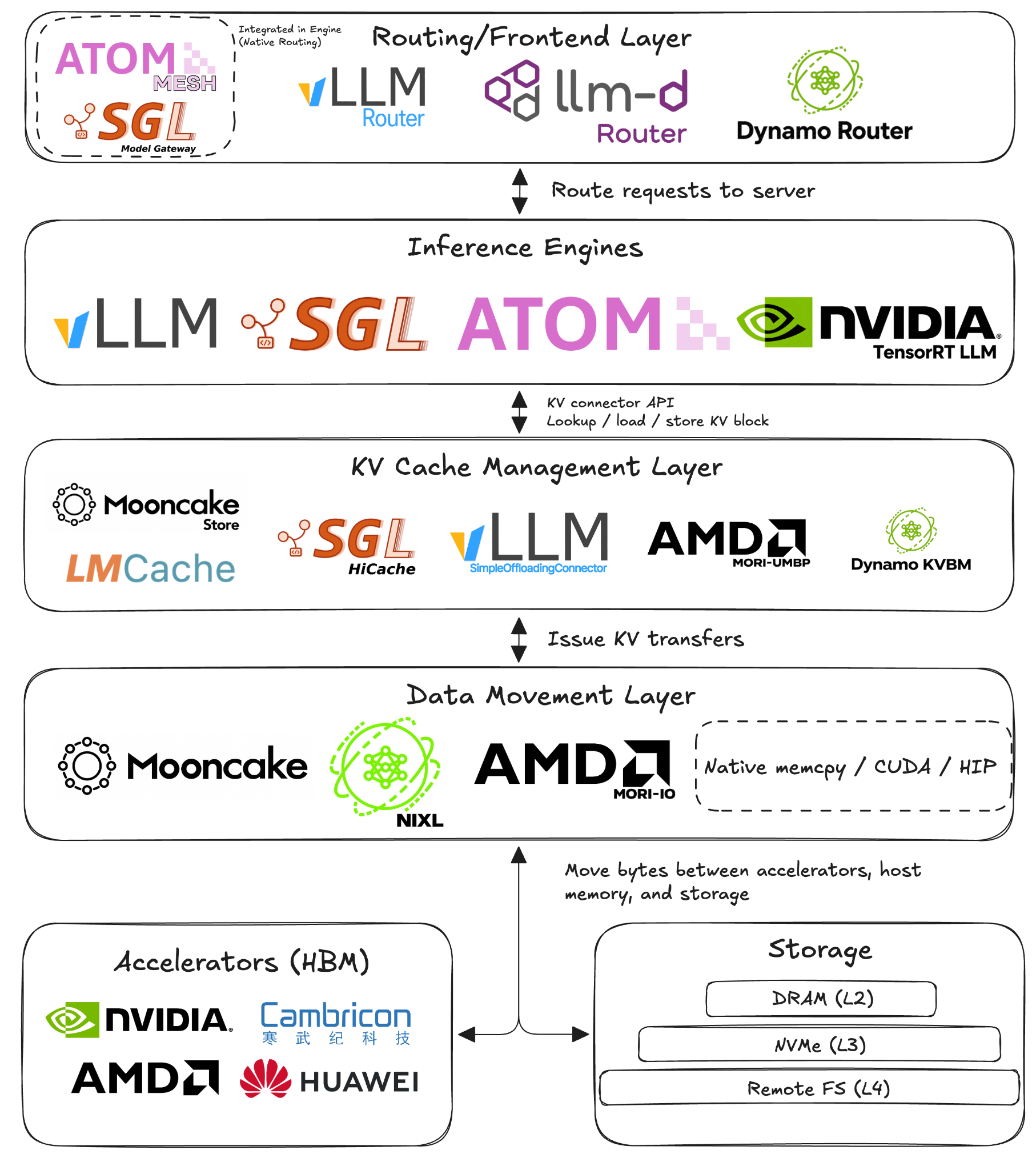
Agentic inference is a system-wide problem rather than a chip or kernel problem. Once a distributed system handles hundreds of thousands of agentic requests, request scheduling and KV-cache management stop being bookkeeping and start having legitimate performance implications. Subagents, for example, produce bursty KV-cache patterns that will evict the main agent’s cache if nothing prevents it.
At the top of the stack, routers — sometimes called frontends — send requests to workers. When a server runs data-parallel attention there is a separate KV cache per DP rank, so requests are routed under policies such as consistent hashing, where every request in the same session or subagent follows its unique ID to the same rank rather than thrashing all of them.
Most routing policies do not differ much between implementations. Some routers are separate components, such as the vLLM router and the llm-d router; others are integrated into the engine, such as the SGLang model gateway and ATOM Mesh.
After routing, a request reaches the scheduler of an inference engine such as vLLM or SGLang. The engine performs the inference and returns the result over an API. Each engine also exposes an interface connecting its internal KV cache to external KV-cache managers, which is what makes the ecosystem pluggable: one cache manager can integrate with many engines.
The simple deployment used in the current AgentX results runs Mooncake alongside vLLM on the same node. Each vLLM worker embeds a Mooncake Store client and contributes part of host DRAM to the external KV-cache pool. vLLM reaches that pool through the MooncakeStoreConnector interface, which loads reusable KV blocks into GPU memory and saves newly computed blocks back to host memory. Mooncake Store handles placement and eviction; Mooncake Transfer Engine moves the bytes between GPU and CPU memory.
Different KV-cache managers use different transfer engines to move bytes between memory tiers or machines, such as between prefill and decode workers. A deployment can use Mooncake Store to offload reusable KV blocks to host DRAM while simultaneously using NIXL to move request-specific KV directly from prefill GPUs to decode GPUs, with NIXL using UCX and GPUDirect RDMA where supported. Multiple KV-management and transfer paths can coexist inside one inference engine.
The ecosystem is made of many independent components: inference engines, routers, KV-cache managers, data-transfer libraries, and cluster controllers. Platforms such as NVIDIA Dynamo, llm-d, and AMD Infera package selected combinations into complete distributions, publishing compatible container images, connectors, deployment manifests, and orchestration logic. The result is usually a set of coordinated containers rather than one monolithic service.
Other optimizations: day-zero enablement and correctness
The work collected on the project pages addresses long-context cost: a prefix that has to survive, a hybrid cache that has to stay correct, a transfer that has to keep up. The changes here are different in kind. They are day-zero enablement and correctness bugs, and they break a request exactly as badly as a million-token session does.
MiniMax-M3 tested whether the ROCm work compounds into day-zero readiness, and the Advancing AI writeup draws the comparison directly: AMD’s first public disaggregated recipe, MI355X FP4, reached InferenceX in January, months behind NVIDIA, while M3 FP4 disaggregation landed on day zero. That is a marked improvement on the DeepSeek-R1 period, when parity took months. Three vLLM fixes sat on the day-zero path, and each was a correctness failure rather than a performance one.
Disaggregation was blocked first. NixlConnector’s handshake asserted that the SPLIT-region block_len scales with the prefill-to-decode TP ratio, but block_len follows per-rank KV heads. M3 has 4 KV heads, so a TP4 prefill paired with a TP8 decode is GQA-capped to one head per rank on both sides, and the two lengths are equal where the assertion demanded a factor of two. The handshake was rejected, no KV moved, decode regenerated everything from scratch, and gsm8k scored 0. Validating against the actual head ratio fixed it.
The other two were platform splits. M3’s sparse-attention backend read the byte-backed FP8 cache as float8_e4m3fn for every E4M3 configuration, but gfx942’s platform dtype is e4m3fnuz. The two encodings differ, so K and V were altered before the kernels consumed them, and the prefill and decode wrappers had also omitted the FNUZ types from their FP8 checks. Using the platform dtype for the cache view fixed both halves. Separately, M3 ships as separate NVIDIA and AMD model files and only the NVIDIA one implemented the EAGLE3 interface, so speculative decoding aborted at engine init on ROCm with a model-does-not-support error. Bringing the AMD model to parity restored it, with MI355X gsm8k matching both the non-EAGLE3 MI355X run and B200.
The TensorRT-LLM page covers the M3 work that is long-context specific: descriptor explosion in disaggregated KV transfer, context graph capture, sparse block strides, autotuner candidates, and the corrupt split-K MoE tactics that had to be removed from the pool.
Upstream pull requests
What the AgentX matrix activates
The local AgentX matrix combines session-aware or KV-aware routing, long and variable conversation histories, MTP, hybrid attention, aggregated and disaggregated serving, and concurrency sweeps that cross the HBM capacity cliff. It includes GPU-resident comparisons as well as CPU DRAM offload through vLLM SimpleCPU, Mooncake, LMCache, and SGLang HiCache. That combination is what activates the upstream work above.
The old fixed-sequence matrix usually creates one prompt, performs one prefill, decodes one fixed continuation, and discards the request. It therefore does not measure cache survival across turns, repeated tokenization, session affinity, cache-event traffic, offload churn, transfer progress during scheduler stalls, or long-lived ownership bookkeeping.
The allowed optimization policy treats CPU KV offload as optional. A vendor may use vLLM connectors, LMCache, SGLang HiCache, Mooncake, Dynamo KVBM, or another CPU DRAM connector — or disable offload when the resulting latency and throughput point is better. NVMe offload is deferred. CPU DRAM must scale with the fraction of GPUs used, including the 3 TB cap for systems without standardized DRAM. Systems with standardized DRAM have no hard cap but keep the same proportionality rule; the local generator currently applies the 3 TB cap to every runner, so it does not yet implement the standardized-DRAM exception.
The net new optimization surface is not simply longer attention. It is the preservation, movement, routing, reconstruction, and repeated processing of a growing session state. AgentX made those costs large enough to drive generic upstream changes across vLLM, SGLang, TensorRT-LLM, ATOM, AITER, Dynamo, and LMCache. Direct searches of NIXL and Mooncake did not identify additional AgentX-tagged runtime PRs beyond those listed here, so their effects remain represented through the engine connector changes.
References