
MiniMax M2.5/M2.7 — GB300 NVL72 vs MI300X Performance per Dollar
Cost per million tokens of GB300 NVL72 (NVIDIA Blackwell) versus MI300X (AMD CDNA 3) on MiniMax M2.5/M2.7. Large-hyperscaler-volume ownership TCO normalized by total tokens — performance per dollar across LLM workloads. Pick the more cost-efficient SKU at every target interactivity level. Use the chart controls below to switch sequences, precisions, and metrics — same interactions as the main inference chart.
Near the low end of the 24–84 tok/s/user interactivity band — at 39 tok/s/user — GB300 NVL72 runs $0.05 per million tokens on MiniMax M2.5/M2.7 while MI300X runs $0.17. GB300 NVL72 is the cheaper choice by 238%.
On MiniMax M2.5/M2.7 at 54 tok/s/user, the per-million math comes out to $0.08 for GB300 NVL72 and $0.20 for MI300X; GB300 NVL72 delivers 163% more total tokens per dollar.
At 69 tok/s/user on MiniMax M2.5/M2.7, GB300 NVL72 costs $0.13 per million tokens; MI300X costs $0.26. GB300 NVL72 is 99% more cost-efficient at this operating point. (Numbers reflect the default 8k/1k · fp8 selection for this URL — table and chart below update if you change sequence, precision, or model in the controls.)
Chip pricing (owning hyperscaler): GB300 NVL72 $2.31/chip/hr · MI300X $0.95/chip/hr. Source: SemiAnalysis Market July 2026 Pricing Surveys & AI Cloud TCO Model.
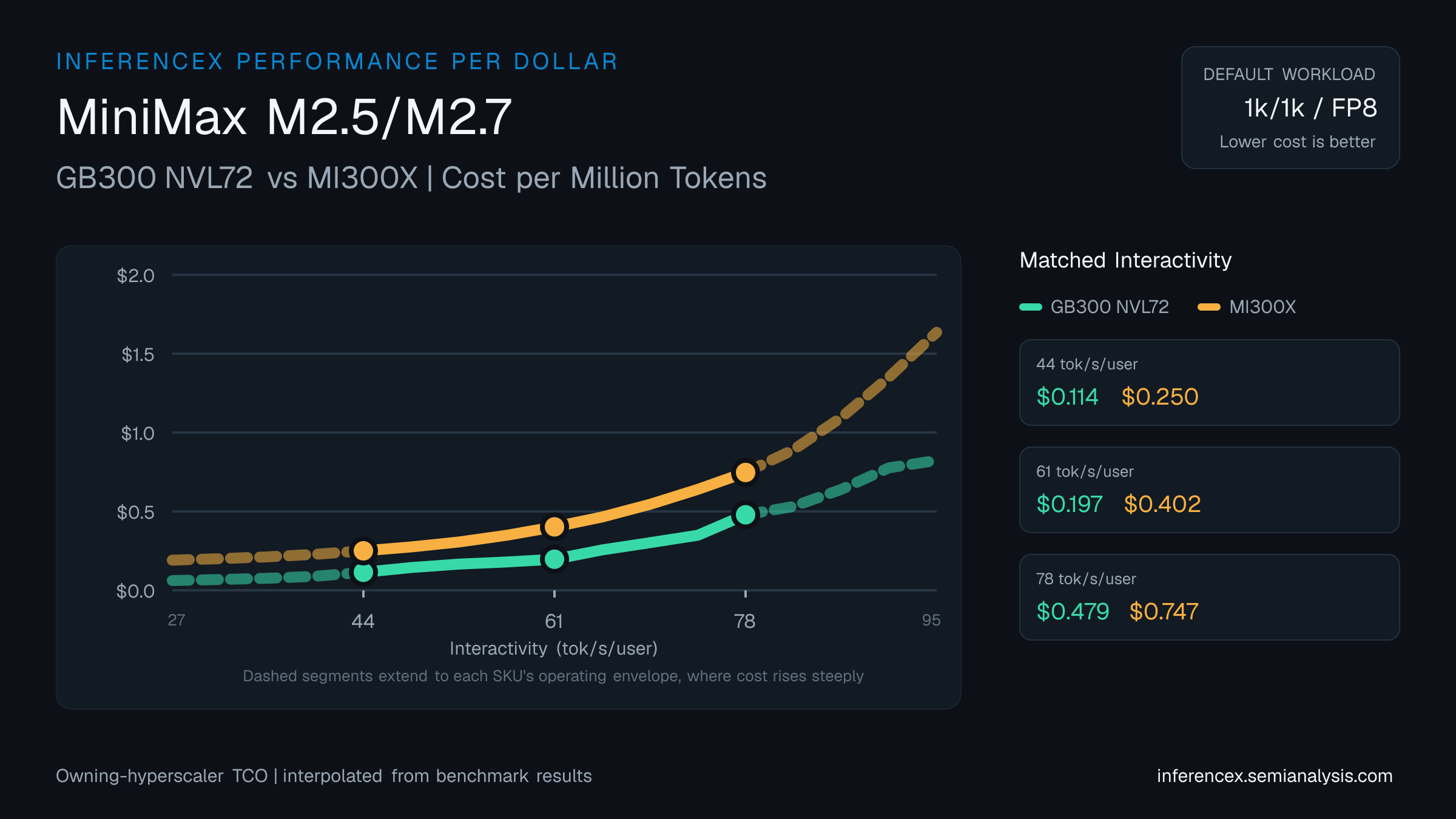
| Metric | Interactivity (tok/s/user) | Interactivity (tok/s/user) | Interactivity (tok/s/user) |
|---|---|---|---|
| Dollar per Million Tokens | GB300 NVL72:$0.051MI300X:$0.174 | GB300 NVL72:$0.076MI300X:$0.201 | GB300 NVL72:$0.129MI300X:$0.257 |
| Concurrency | GB300 NVL72:~613MI300X:~10 | GB300 NVL72:~222MI300X:~5 | GB300 NVL72:~63MI300X:~4 |
Inference Performance
Agentic inference metrics from the AgentX scenario and fixed-sequence inference metrics across models, hardware configurations, and serving parameters.
MiniMax M2.5/2.7 230B 8K / 1K Cost per Million Total Tokens vs. Interactivity
 MiniMax M2.5/2.7 230B 8K / 1K Cost per Million Total Tokens vs. Interactivity
- Cost Tier:
- Source:
- SemiAnalysis InferenceX™
TCO $/chip/hr:
Source: SemiAnalysis Market July 2026 Pricing Surveys & AI Cloud TCO Model
Note: Disaggregated inference configurations (e.g., MoRI SGLang, Dynamo TRTLLM) calculate cost per million tokens per decode chip or per prefill chip, rather than per total chip count. This makes direct token cost comparison with aggregated configs not an apples-to-apples comparison.
Note: Disaggregated inference configurations (e.g., MoRI SGLang, Dynamo TRTLLM) calculate input throughput per decode chip or per prefill chip, rather than per total chip count. This makes direct input throughput comparison with aggregated configs not an apples-to-apples comparison.
Note: Disaggregated inference configurations (e.g., MoRI SGLang, Dynamo TRTLLM) calculate output throughput per decode chip or per prefill chip, rather than per total chip count. This makes direct output throughput comparison with aggregated configs not an apples-to-apples comparison.
Note: Disaggregated inference configurations (e.g., MoRI SGLang, Dynamo TRTLLM) calculate power per decode chip or per prefill chip, rather than per total chip count. This makes direct power comparison with aggregated configs not an apples-to-apples comparison.
Note: Disaggregated inference configurations (e.g., MoRI SGLang, Dynamo TRTLLM) calculate Joules per decode chip or per prefill chip, rather than per total chip count. This makes direct Joules per token comparison with aggregated configs not an apples-to-apples comparison.
No data available
Matching measurements exist, but their chip series are hidden.
Shift+Scroll to zoom • Drag to pan • Double-click to reset • Click a point to pin tooltip