
Kimi K3.1 Pro — B200 vs B300 Performance per Dollar
Cost per million tokens of B200 (NVIDIA Blackwell) versus B300 (NVIDIA Blackwell) on Kimi K3.1 Pro. Large-hyperscaler-volume ownership TCO normalized by total tokens — performance per dollar across LLM workloads. Pick the more cost-efficient SKU at every target interactivity level. Use the chart controls below to switch sequences, precisions, and metrics — same interactions as the main inference chart.
AgentX replays real coding-agent sessions rather than fixed-length prompts, so context grows turn over turn and most of each request is served from cache instead of being recomputed. That turns the comparison into a systems question: KV transfer between nodes, prefix-aware routing, and cache capacity all move the curve alongside raw chip throughput. Fixed-sequence workloads stay the clean baseline for kernel and silicon performance, so the two scenarios answer different questions about the same hardware. Learn more about AgentX →
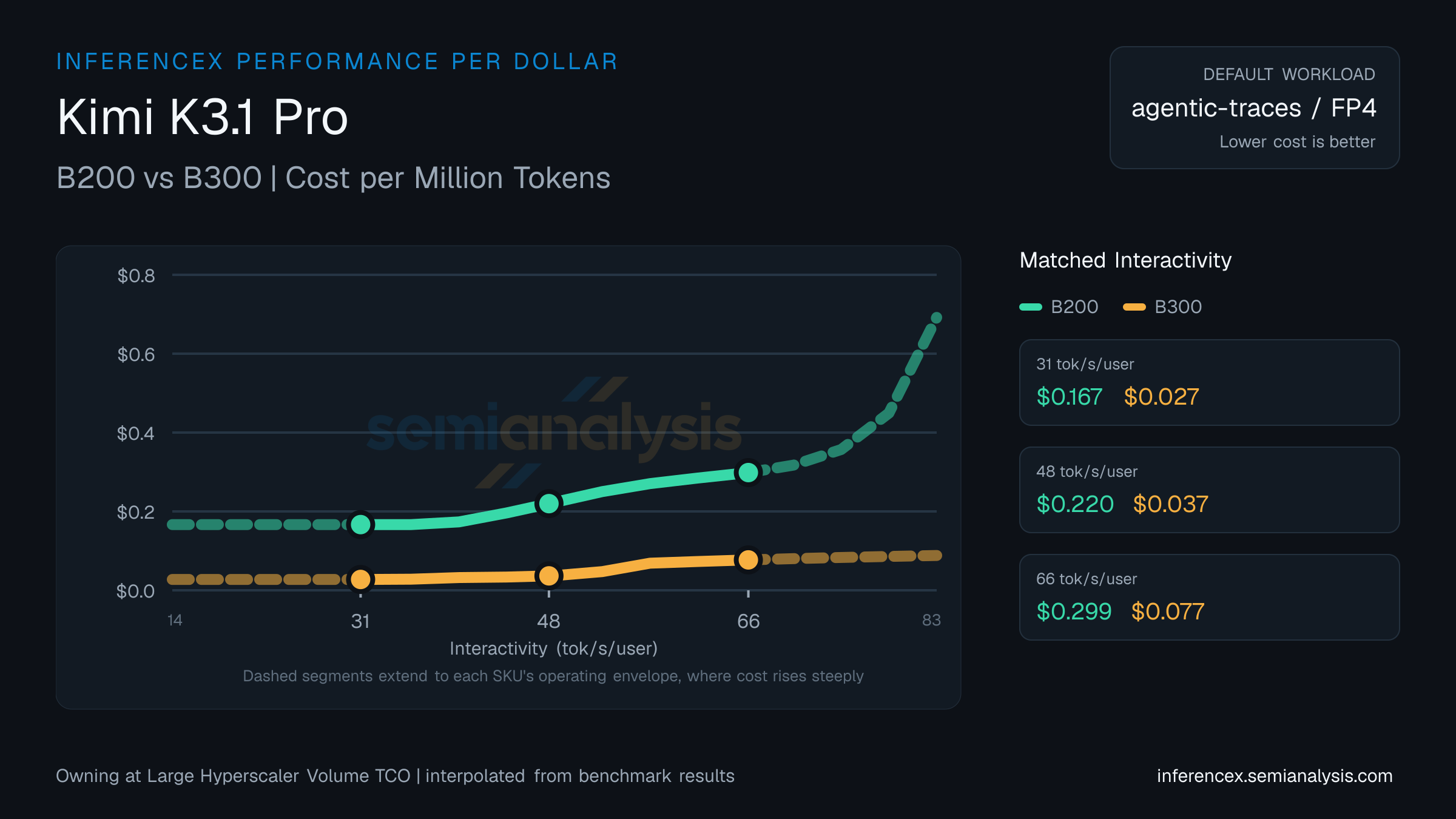
On Kimi K3.1 Pro at 31 tok/s/user, the per-million math comes out to $0.17 for B200 and $0.03 for B300; B300 delivers 507% more total tokens per dollar.
At 48 tok/s/user on Kimi K3.1 Pro, B200 costs $0.22 per million tokens; B300 costs $0.04. B300 is 501% more cost-efficient at this operating point.
B300 edges B200 at 66 tok/s/user on Kimi K3.1 Pro — $0.08 per million tokens versus $0.30, a 287% cost-per-token gap. (Numbers reflect the default agentic-traces · fp4 selection for this URL — table and chart below update if you change sequence, precision, or model in the controls.)
Chip pricing (owning hyperscaler): B200 $1.73/chip/hr · B300 $2.26/chip/hr. Source: SemiAnalysis Market July 2026 Pricing Surveys & AI Cloud TCO Model.
| Metric | Interactivity (tok/s/user) | Interactivity (tok/s/user) | Interactivity (tok/s/user) |
|---|---|---|---|
| Dollar per Million Tokens | B200:$0.167B300:$0.027 | B200:$0.220B300:$0.037 | B200:$0.299B300:$0.077 |
| Concurrency | B200:~14B300:~56 | B200:~9B300:~27 | B200:~6B300:~16 |