
DeepSeekv4 Pro 0813 1.6T — B300 vs Vera Rubin NVL72 Performance per Dollar
Cost per million tokens of B300 (NVIDIA Blackwell) versus Vera Rubin NVL72 (NVIDIA Vera Rubin) on DeepSeekv4 Pro 0813 1.6T. Large-hyperscaler-volume ownership TCO normalized by total tokens — performance per dollar across LLM workloads. Pick the more cost-efficient SKU at every target interactivity level. Use the chart controls below to switch sequences, precisions, and metrics — same interactions as the main inference chart.
AgentX replays real coding-agent sessions rather than fixed-length prompts, so context grows turn over turn and most of each request is served from cache instead of being recomputed. That turns the comparison into a systems question: KV transfer between nodes, prefix-aware routing, and cache capacity all move the curve alongside raw chip throughput. Fixed-sequence workloads stay the clean baseline for kernel and silicon performance, so the two scenarios answer different questions about the same hardware. Learn more about AgentX →
At 125 tok/s/user on DeepSeekv4 Pro 0813 1.6T, B300 costs $0.05 per million tokens; Vera Rubin NVL72 costs $0.01. Vera Rubin NVL72 is 746% more cost-efficient at this operating point.
Vera Rubin NVL72 edges B300 at 175 tok/s/user on DeepSeekv4 Pro 0813 1.6T — $0.02 per million tokens versus $0.12, a 626% cost-per-token gap.
Push DeepSeekv4 Pro 0813 1.6T to 226 tok/s/user and B300 lands at $0.18 per million tokens against Vera Rubin NVL72's $0.14 — Vera Rubin NVL72 pulls ahead by 28%. (Numbers reflect the default agentic-traces · fp4 selection for this URL — table and chart below update if you change sequence, precision, or model in the controls.)
Chip pricing (owning hyperscaler): B300 $2.26/chip/hr · Vera Rubin NVL72 $3.61/chip/hr. Source: SemiAnalysis Market July 2026 Pricing Surveys & AI Cloud TCO Model.
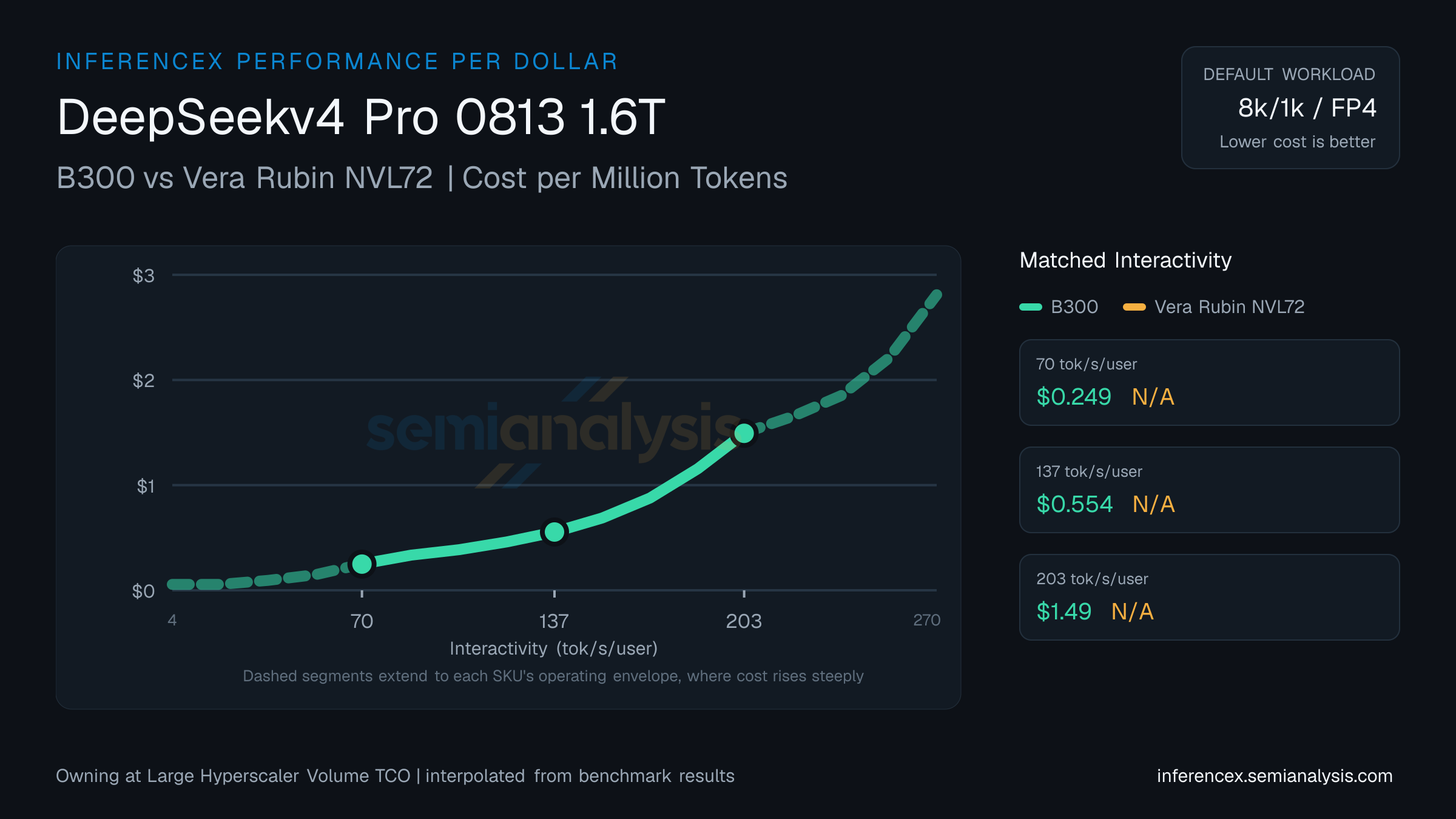
| Metric | Interactivity (tok/s/user) | Interactivity (tok/s/user) | Interactivity (tok/s/user) |
|---|---|---|---|
| Dollar per Million Tokens | B300:$0.050Vera Rubin NVL72:$0.006 | B300:$0.117Vera Rubin NVL72:$0.016 | B300:$0.177Vera Rubin NVL72:$0.139 |
| Concurrency | B300:~8Vera Rubin NVL72:~1178 | B300:~8Vera Rubin NVL72:~547 | B300:~4Vera Rubin NVL72:~33 |
Inference Performance
Agentic inference metrics from the AgentX scenario and fixed-sequence inference metrics across models, hardware configurations, and serving parameters.
DeepSeek V4 Pro 0813 1.6T 8K / 1K Cost per Million Total Tokens vs. Interactivity
 DeepSeek V4 Pro 0813 1.6T 8K / 1K Cost per Million Total Tokens vs. Interactivity
- Cost Tier:
- Source:
- SemiAnalysis InferenceX™
TCO $/chip/hr:
Source: SemiAnalysis Market July 2026 Pricing Surveys & AI Cloud TCO Model
Note: Disaggregated inference configurations (e.g., MoRI SGLang, Dynamo TRTLLM) calculate cost per million tokens per decode chip or per prefill chip, rather than per total chip count. This makes direct token cost comparison with aggregated configs not an apples-to-apples comparison.
Note: Disaggregated inference configurations (e.g., MoRI SGLang, Dynamo TRTLLM) calculate input throughput per decode chip or per prefill chip, rather than per total chip count. This makes direct input throughput comparison with aggregated configs not an apples-to-apples comparison.
Note: Disaggregated inference configurations (e.g., MoRI SGLang, Dynamo TRTLLM) calculate output throughput per decode chip or per prefill chip, rather than per total chip count. This makes direct output throughput comparison with aggregated configs not an apples-to-apples comparison.
Note: Disaggregated inference configurations (e.g., MoRI SGLang, Dynamo TRTLLM) calculate power per decode chip or per prefill chip, rather than per total chip count. This makes direct power comparison with aggregated configs not an apples-to-apples comparison.
Note: Disaggregated inference configurations (e.g., MoRI SGLang, Dynamo TRTLLM) calculate Joules per decode chip or per prefill chip, rather than per total chip count. This makes direct Joules per token comparison with aggregated configs not an apples-to-apples comparison.
No data available
Matching measurements exist, but their chip series are hidden.
Shift+Scroll to zoom • Drag to pan • Double-click to reset • Click a point to pin tooltip