
B200: FP4 vs FP8 Precision Comparison
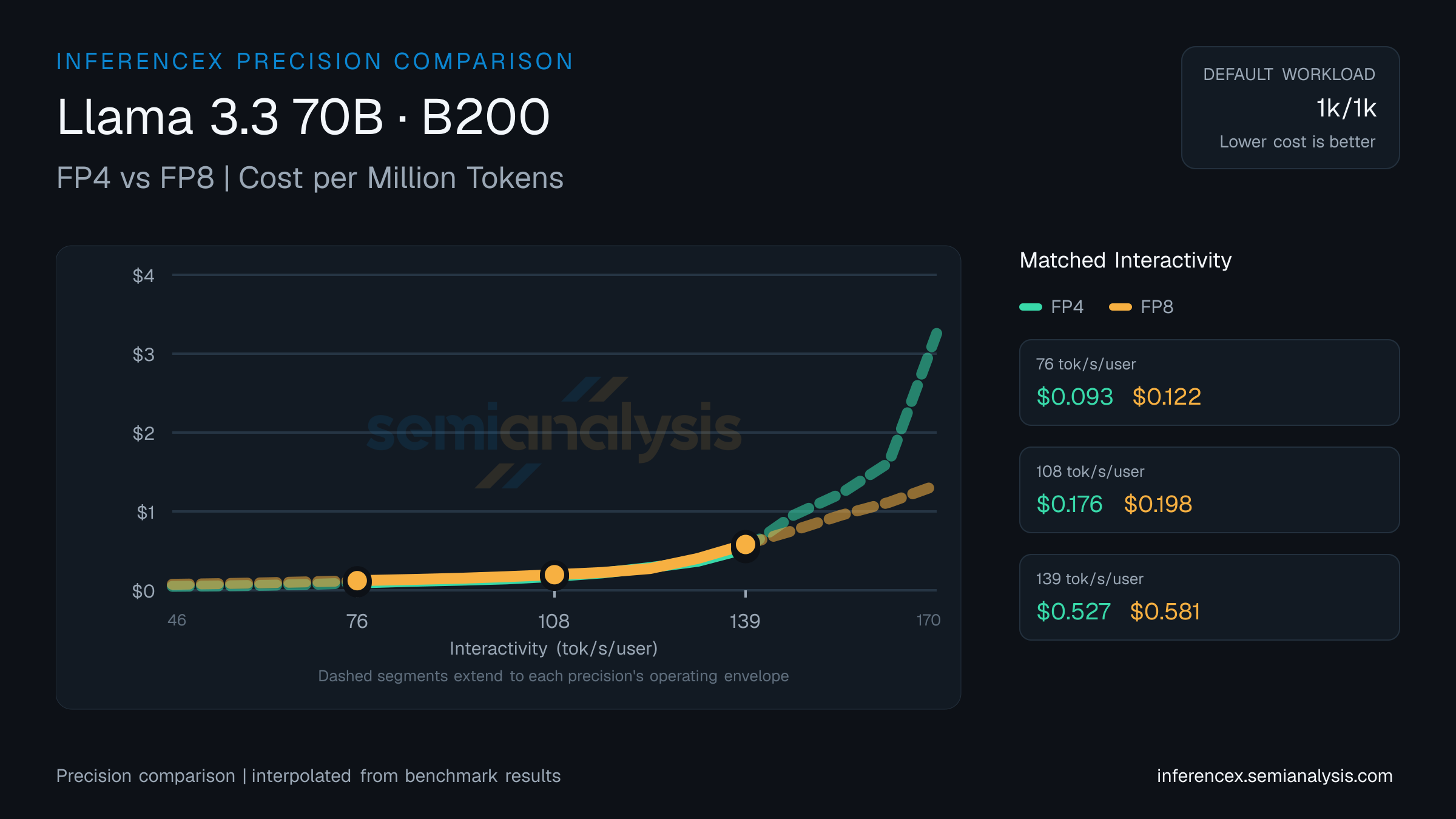
How FP4 and FP8 precision affect Llama 3.3 70B inference on B200 (NVIDIA Blackwell). Throughput, latency, and cost across LLM workloads. Use the chart controls below to switch sequences and metrics — same interactions as the main inference chart.
At 76 tok/s/user on Llama 3.3 70B (B200), FP4 delivers 5971 tok/s/chip at $0.08 per million tokens; FP8 delivers 4431 tok/s/chip at $0.11. FP4 is 35% cheaper per token; FP4 delivers 35% more tok/s/chip. Lower-precision quantization trades model accuracy for throughput — check the evaluation page for quality impact.
FP4 posts 3099 tok/s/chip for $0.16 per million tokens at 108 tok/s/user on Llama 3.3 70B (B200); FP8 posts 2744 tok/s/chip for $0.18. FP4 is 13% cheaper per token; FP4 delivers 13% more tok/s/chip. Quantization-level accuracy differences are tracked on the evaluation tab.
Throughput at 139 tok/s/user on Llama 3.3 70B (B200): FP4 hits 1032 tok/s/chip, FP8 hits 912. Per-million costs land at $0.47 and $0.53 respectively. FP4 is 13% cheaper per token; FP4 delivers 13% more tok/s/chip. The cost-throughput tradeoff from lower precision is only part of the picture — see the evaluation page for accuracy data. (Numbers reflect the default 1k/1k selection for this URL — table and chart below update if you change sequence or model in the controls. Each side uses the best available serving configuration for that precision, which may include speculative decoding such as MTP where recipes exist — the same convention as the other comparison pages.)
| Metric | Interactivity (tok/s/user) | Interactivity (tok/s/user) | Interactivity (tok/s/user) |
|---|---|---|---|
| Throughput (tok/s/chip) | FP4:5971.1FP8:4431.4 | FP4:3098.6FP8:2744.1 | FP4:1031.9FP8:912.2 |
| Cost ($/M tok) | FP4:$0.080FP8:$0.108 | FP4:$0.155FP8:$0.175 | FP4:$0.466FP8:$0.527 |
| tok/s/MW | FP4:3491881FP8:2591472 | FP4:1812036FP8:1604732 | FP4:603441FP8:533421 |
| Concurrency | FP4:~84FP8:~128 | FP4:~63FP8:~54 | FP4:~16FP8:~16 |
Inference Performance
Agentic inference metrics from the AgentX scenario and fixed-sequence inference metrics across models, hardware configurations, and serving parameters.