DeepSeek V4 Pro 0813 1.6T · Performance per Dollar
DeepSeek V4 Pro 0813 1.6T — H200 vs MI325X Performance per Dollar
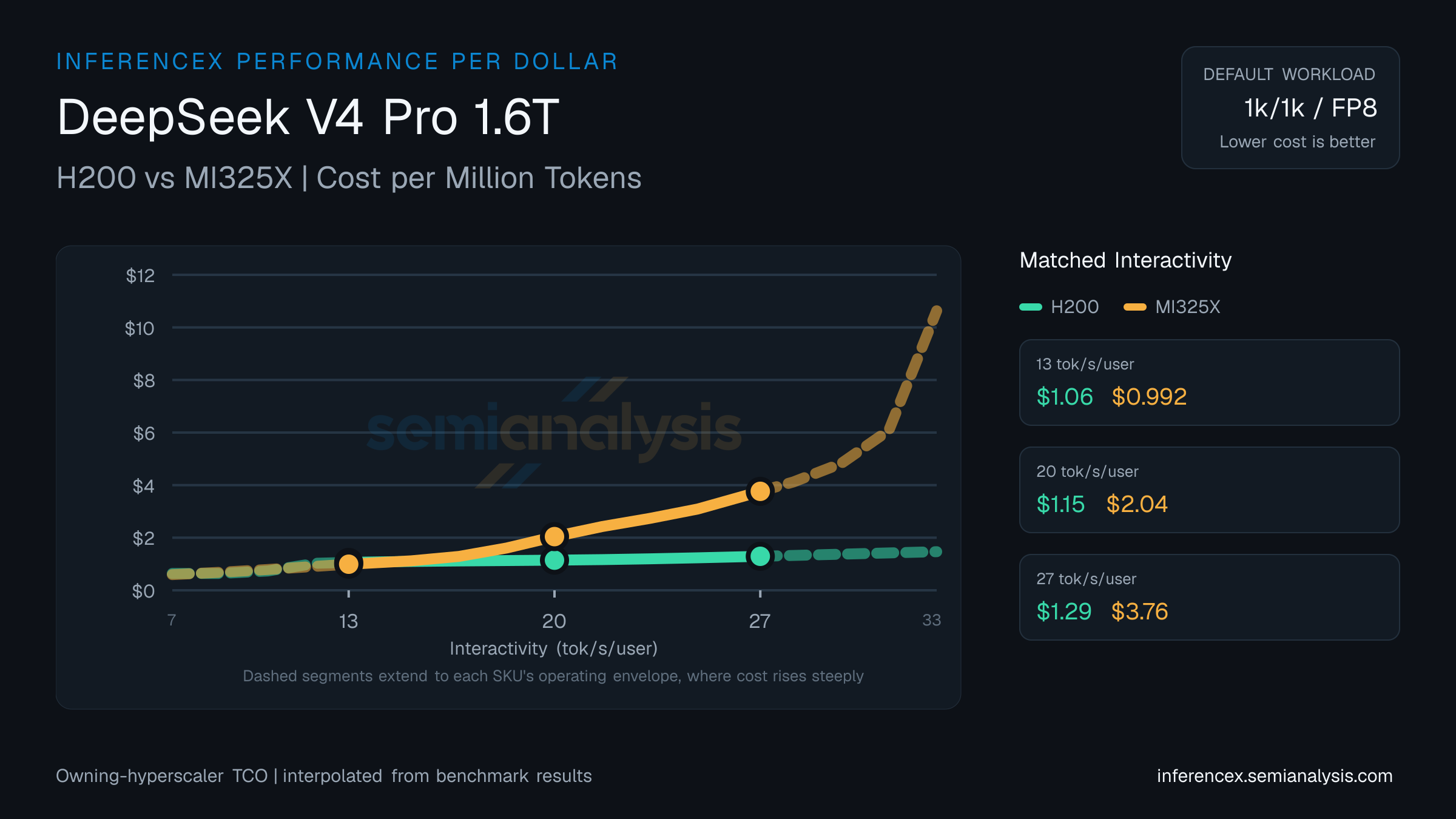
Cost per million tokens of H200 (NVIDIA Hopper) versus MI325X (AMD CDNA 3) on DeepSeek V4 Pro 0813 1.6T. Large-hyperscaler-volume ownership TCO normalized by total tokens — performance per dollar across LLM workloads. Pick the more cost-efficient SKU at every target interactivity level. Use the chart controls below to switch sequences, precisions, and metrics — same interactions as the main inference chart.
Near the low end of the 7–33 tok/s/user interactivity band — at 13 tok/s/user — H200 runs $0.92 per million tokens on DeepSeek V4 Pro 0813 1.6T while MI325X runs $0.86. MI325X is the cheaper choice by 6%.
On DeepSeek V4 Pro 0813 1.6T at 20 tok/s/user, the per-million math comes out to $0.99 for H200 and $1.72 for MI325X; H200 delivers 73% more total tokens per dollar.
At 27 tok/s/user on DeepSeek V4 Pro 0813 1.6T, H200 costs $1.11 per million tokens; MI325X costs $3.22. H200 delivers 189% more tokens per dollar at this operating point. (Numbers reflect the default 1k/1k · fp8 selection for this URL — table and chart below update if you change sequence, precision, or model in the controls.)
Chip pricing (owning hyperscaler): H200 $1.22/chip/hr · MI325X $1.10/chip/hr. Source: SemiAnalysis Market July 2026 Pricing Surveys & AI Cloud TCO Model.
Interpolated from real benchmark data. Edit target interactivity values below to compare at different operating points.
| Metric | Interactivity (tok/s/user) | Interactivity (tok/s/user) | Interactivity (tok/s/user) |
|---|---|---|---|
| Dollars per Million Tokens | H200$0.92MI325X$0.86 | H200$0.99MI325X$1.72 | H200$1.11MI325X$3.22 |
| Concurrency | H200~117MI325X~113 | H200~75MI325X~37 | H200~48MI325X~14 |